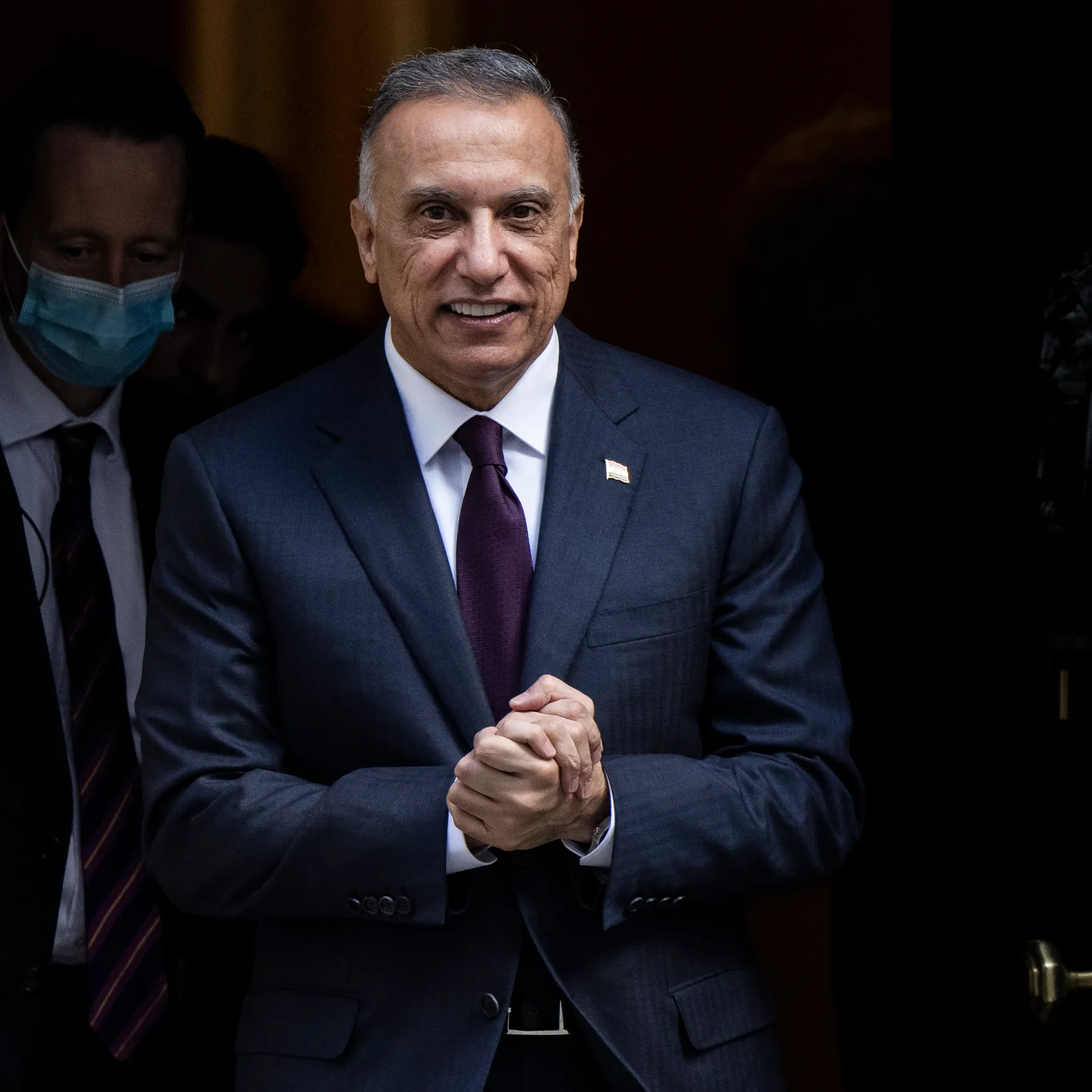
When you turn over the pages of the Iraqi political scene during the protest phase and what followed it, you quickly discover that the battle was not being waged exclusively in the street or inside the corridors of the Green Zone; the real battle was taking place on screens and in smartphones. Who has the ability to define the event? Who can persuade the public that the arrest of an armed man is a step toward “the rule of law” and not merely “settling scores”? At the heart of this struggle over the narrative, Mustafa al-Kadhimi’s arrival was not merely the replacement of one name with another in the premiership, but the unusual entry of a man who understood early on that “information” could equal the force of a tank.
The careful reader of the man’s background—from journalistic work in exile, to documenting human rights violations, and then to managing intelligence work in silence—realizes that this combination produced an official who is not dazzled by cameras, but knows exactly when and where to place them. There was no traditional media plan filling the space with noise; rather, there was a “style” based on directing the message through the live scene.
His team abandoned the monotony of long paper speeches and replaced it with the tactic of “rapid presence.” Sudden field tours, brief tweets, and personal presence at crisis sites were not merely news coverage. They were a deliberate and studied attempt to weave the image of a leader who does not sit behind his desk, but stands face to face with challenges, trying to confine the vocabulary of “the state” and “sovereignty” to his field movement. When the state moved to enforce the law, al-Kadhimi was keen for the image to be present, giving the event a dramatic dimension that touched the aspirations of the street, even if the actual results on the ground sometimes collided with the limits of the state’s capacity before the armed fait accompli.
But this approach did not pass without a price. The Iraqi media environment was not a pure space waiting for someone to fill it with truth; rather, it was, and remains, a tangled jungle of funded channels and platforms run by parties that possess political and armed arms. Every move he made was met by a counter-media machine ready to reinterpret the event. If he spoke about the prestige of the state, his discourse was portrayed as targeting a certain axis; if he sought calm, his position was interpreted as retreat. The peak of this clash was not in the halls of politics, but was embodied on the night his home was targeted by drones, when the incident became material for media tug-of-war aimed at emptying it of its dangerous security content, reflecting the scale of the counter-mobilization that sensed danger from the mere continuation of this “image.”
The profound paradox of that era was that the president who came from the womb of journalism, and who mastered speaking the language of the digital age, found himself shackled in an environment that did not allow the media to be fully liberated. His government succeeded in conveying its narrative, but independent journalism continued to pay a heavy price under the weight of fear, and party platforms remained dominant.
In the end, the most prominent legacy that phase left behind in media terms was not the liberation of institutional ownership or the dismantling of empires of pressure, but the establishment of a new standard: politics in Iraq could no longer tolerate an official who is content with the official statement. Al-Kadhimi made his public persona a central player in the open space, proving that the exercise of power in a country like Iraq is no longer limited to weapons and positions, but begins with the ability to control the “image” before adversaries capture it.
The Edge Game: How Did al-Kadhimi Manage the “Bloc” State Without Party Cover?
In the Iraqi political scene, where weight is calculated by the number of parliamentary seats and influence is measured by the ability to move the street or the weapon, the arrival of a figure stripped of any party cover or supporting faction to the pinnacle of power seems akin to jumping into a minefield blindfolded. When Mustafa al-Kadhimi assumed the premiership, he was not relying on a sweeping victory at the ballot boxes, nor on leadership of a parliamentary bloc; rather, he rose as a “settlement” candidate in a moment of political suffocation produced by the blood of the Tishreen protests that toppled his predecessor.
The astute observer of the political game understands that al-Kadhimi’s strength did not stem from his possession of the classic tools of rule, but from his “background”! He was the man who moved between journalism and human rights work, then led the intelligence service in silence. This complex network of relationships, and his ability to decipher the codes of security work, gave him a negotiating advantage in a divided system. He entered the equation of governance carrying a project that seems self-evident in stable states, but “revolutionary” in an environment of quota-sharing: redefining the “state.”
Al-Kadhimi presented a political triad consisting of: restoring the prestige of state institutions, preventing Iraq from being used as an arena for settling regional accounts, and imposing a precise balance in foreign relations. But implementation was fraught with complications. When the head of government is forced to govern through the consensus of parties that fundamentally benefit from the state remaining weak, any attempt to enforce the law becomes tantamount to walking a tightrope.
This truth appeared in its harshest form when the state tried, for the first time, to test its ability to monopolize force and confront the influence of uncontrolled weapons, through arrest attempts targeting figures belonging to armed factions. Every time law enforcement forces moved, they were met with counter-mobilization, demands, and pressures that reached the point of besieging government headquarters. These incidents were not mere security details, but “political sensors” that clearly showed the disparity between the desire to extend sovereignty and the operational constraints of a prime minister managing a transitional government that lacked a parliamentary shield to protect its confrontational decisions.
Perhaps the assassination attempt that targeted his home was not merely a security escalation, but a coded political message in the language of fire, reflecting the scale of anxiety that afflicted some centers of influence over the possibility of entrenching this model that does not submit to the traditional rules of the game, especially after the early elections that reshuffled the cards.
In sum, it cannot be claimed that al-Kadhimi managed to dismantle the quota-sharing system or settle the file of monopolizing weapons. But he established a political precedent that was troubling to the classical system; he proved that managing the state is possible from outside the club of traditional party leaders, and that the will to “balance” can make a difference even if it is besieged by constraints. He left behind a system that did not change radically, but it became obliged to answer the questions of “state and sovereignty” that al-Kadhimi forced onto the table and made a standard by which whoever succeeds him is measured.
Diplomacy of “Walking the Tightrope”: How Did al-Kadhimi Build External Bridges to Compensate for Domestic Fragility?
When a former intelligence man assumes the reins of power in a state where regional and international lines of fire intersect, as in Iraq, the first thing he realizes is that “the domestic and the external” are not two separate files, but two sides of one extremely sensitive balance. Mustafa al-Kadhimi did not enter the government palace borne on the shoulders of a cohesive party or a militia protecting his back; he came as a settlement candidate in a moment of weightlessness, and relied entirely on his network of relationships and his ability to open closed channels.
This structural fragility at home—where passing even the simplest decisions requires arduous negotiation with parties that benefit from quota-sharing—pushed al-Kadhimi to adopt a strategy based on strengthening the outside in order to repair the inside. He understood that attempting a comprehensive and direct clash with the internal system without broad regional and international cover meant political suicide. Therefore, he resorted to what may be called “bridge diplomacy,” trying to transform Iraq from an arena for settling accounts into a dialogue table.
Perhaps the most prominent manifestation of this strategy was in his management of the file of the American military presence. Instead of responding to pressures aimed at rupture or an uncalculated collision, he moved toward “redefining” the relationship; he transformed combat missions into advisory ones, in a step he presented as a restoration of sovereignty, but which at its core was an attempt to absorb the anger of factions opposed to Washington without losing the American security and economic cover.
On the other side, his management of the relationship with Tehran represented the peak of the “edge game.” He visited Iran and affirmed the bonds of neighborliness, but at the same time quietly sought to create a parallel Gulf balance. He reopened investment channels with Saudi Arabia and the Emirates, and succeeded in making Baghdad an arena for direct dialogue between Riyadh and Tehran. This move was not merely a diplomatic display; it was an implicit message that Baghdad had begun to regain its ability to initiate and establish paths outside the circle of unilateral influence.
Yet this success in building a network of external alliances was not automatically reflected domestically. Despite turning into a trusted regional mediator, he continued to face extreme difficulty in convincing internal actors that the power of the state must rise above their shares. Whenever he drew closer to Washington or Riyadh, accusations of bias were directed at him by opponents linked to another axis, and whenever he maintained ties with Tehran, he faced pressure from Tishreen and the forces demanding complete independence.
Al-Kadhimi’s real legacy in this file does not lie in his having resolved the conflict of axes, but in his establishing a model that says the state is able to talk to everyone at the same time without collapsing. He used diplomacy as a shield to compensate for his lack of a party base, turning the fragility of his internal position into an impetus to weave a network of external relations that has today become a standard by which the performance of any government that succeeds him in the Baghdad palace is measured.
Engineering Standing: How Was “International Symbolism” Employed to Impose a New Standard for the State?
In international relations, the weight of states is not measured solely by the size of their military arsenals or financial balances, but by their ability to craft the “narrative” through which the world sees them. For years, Iraq remained captive to a stereotype that confined it either to being a news headline for a security operation, or a silent arena for settling regional accounts.
In the face of this closure, classical diplomatic tools were not sufficient to produce a positive shock, so the move was toward using “symbol diplomacy” as a soft tool to redefine Iraq’s positioning on the global map.
The scrutinizing observer of an event such as the visit of Pope Francis realizes that it was not merely a passing pastoral tour. It was a precisely calculated geopolitical step. When the head of the Catholic Church heads to Najaf to meet the supreme religious authority Ali al-Sistani, then stands praying in Ur and Mosul, the message sent to the international community went beyond the limits of religious tolerance, to affirm that this geography possesses an independent civilizational and institutional weight that refuses to be reduced to the whirlpool of conflicts. This event was invested in to prove the ability of the official institution to manage and secure a global undertaking of this size, in a quiet message that refutes the narratives of “non-state.”
The path of “re-presenting” did not stop there, but was manifested intelligently in the visit made by French President Emmanuel Macron, specifically when he toured the alleys of the city of Kadhimiya up to the shrine of the two Kadhim Imams. That was not protocol accompaniment, but a political indication meant to say that openness to the international community does not require shedding local identity, and that state institutions are capable of integrating their cultural and religious depth into their modern diplomatic movement, and of interacting directly without the need for external points of passage.
These paths were crowned by the Baghdad Conference for Cooperation and Partnership, which succeeded in bringing intersecting regional powers to one table. The naive wager was not placed on resolving the historical knots between those capitals with a final statement; rather, the real wager was represented in “reclaiming the right to host.” At that moment, Baghdad was transformed from a mailbox for exchanging harsh messages into an operations room for producing dialogue.
In the deep strategic reading, this intense external opening was not a leap over domestic challenges or an escape from them, but an attempt to encircle those challenges with a “new standard.” These moves succeeded in returning Iraq to the circle of attention as a potential partner, not as a sustained crisis; this placed the entire political system before a different reality. The deeper legacy of this diplomacy does not lie in the souvenir photos that were taken, but in the fact that it raised the ceiling and established a “pivot point” from which it is impossible to retreat. Whoever sits in the position of decision-making today knows well that returning Iraq to the corners of isolation is no longer an available option, because the world has indeed reacquainted itself with Baghdad as it sits in the seat of initiative.
Brink of Bankruptcy: How Did al-Kadhimi Manage the “Rent Shock” with Decisions of Political Suicide?
When any government official receives the keys to the treasury, he usually looks for financial margins that allow him to satisfy the street or pass political promises. But the financial scene that Mustafa al-Kadhimi collided with in May 2020 left no room for the luxury of maneuver; he found himself before a treasury drained by a wage bill that had swollen by about 400% since 2004, in tandem with a sharp collapse in oil prices and a global paralysis imposed by the pandemic.
At that moment, the easiest option for any politician seeking the sustainability of his future was to continue rolling crises forward. Yet the approach that was presented was embodied in the “White Paper,” which was not merely a traditional economic plan, but closer to a harsh “diagnostic document” of the structure of the rentier system that had turned the state into merely a major employment agency whose survival depends entirely on oil prices. The paper diagnosed the structural imbalance represented by the swelling of the public sector and the retreat of the private sector, clearly warning that the path of employment-based appeasement would inevitably lead to the collapse of the entire structure.
As a translation of this reading came the most controversial decision, which represents the peak of what may be called “political suicide” by populist standards: adjusting the exchange rate of the dinar to 1,460 against the dollar. The decision-maker fully understood that this step would partially transfer the cost of the crisis to consumers and push inflation upward, but it was the available financial maneuver to convert oil revenues into a local cash mass that would prevent the depletion of reserves and save the state from being unable to pay the salaries of its employees. The administration at the time chose to bear the burden of direct popular anger, rather than leave the state to slide toward inevitable bankruptcy.
Despite the attempt to open up to the outside to attract investments worth billions of dollars to compensate for the shortfall, this structural vision collided with a stubborn political reality. The head of government, stripped of any solid parliamentary cover, found himself face to face with entrenched interests that derive their influence and survival from the networks of appointments, contracts, and government spending. It was not possible to pass reforms that touched salaries or restructured losing companies without colliding directly with those forces.
The greatest paradox appeared when oil prices later resumed rising, pushing GDP growth to levels that reached 10.5% in the first half of 2022. This temporary financial recovery, which gave the government breathing space, at the same time weakened the “political incentive” among traditional forces to proceed with difficult reforms. The political system breathed a sigh of relief and returned to relaxation as soon as the treasury filled, ignoring warnings that financial improvement does not equal sustainable economic transformation.
In sum, circumstances did not allow al-Kadhimi to accomplish a structural economic transformation that would completely end the dominance of oil, and his transitional period was not sufficient to dismantle the complex networks of political economy. But his deeper legacy in this file lies in the fact that he managed an “exceptional shock” that prevented collapse, and placed the political system for the first time before a mirror reflecting the truth of its fragile economy. He left behind a reference framework that no subsequent government can ignore for the diagnoses it contains, even if it prefers to return to the policy of buying time with oil money.
Dismantling the “Armed Code”: How Did al-Kadhimi Engineer the State Doctrine Whose Fruits al-Zaidi Is Reaping?
In reading major security transformations, the strategic effect is not measured by the number of momentary battles, but by the ability to establish a “security doctrine” that strips adversaries of their ideological covers. When Mustafa al-Kadhimi assumed the reins of power, the security scene was tense and open to all possibilities, between terrorist cells lying in wait for opportunities, intersecting international fires, and most importantly: a network of armed centers of power that impose their will under various banners and slogans.
The calm reader of al-Kadhimi’s policy realizes that he chose a path deeper than direct military confrontation; he went toward “dismantling the narrative.” For years, some factions relied, in justifying their retention of weapons, on the pretext of “occupation” and resisting the foreign presence. Here, al-Kadhimi carried out his most important maneuver by redefining the relationship with the international coalition and transforming its missions into purely advisory ones, thereby pulling the most important card from those factions’ hands. He did not content himself with the diplomatic step, but formulated it with a direct political shock when he clearly declared: “There are no coalition forces in Iraq under the title of occupation forces; this phrase is a lie, others fabricated it and tried to market it to find an exit or legitimacy for weapons outside the framework of the state.”
This explicit exposure of the political deception established a new stage in the language of official address. Al-Kadhimi was the first to push the term “confining weapons to the hand of the state” from the category of electoral slogans into the heart of government doctrine, setting red lines that those before him had not dared to draw with such sharpness. He entrenched a self-evident rule in the concept of stable states, but one that was revolutionary in the Iraqi context, saying: “There is no state in the world that claims sovereignty for itself and accepts the existence of weapons outside its framework,” and following it with a strict structural truth: “There is no state in the world that accepts the existence of two armies.”
To translate this doctrine, his government took unprecedented bold steps to test the influence of those groups through raids and arrests that reached armed leaders. Although those operations were met with violent reactions, displays, and attempts at intimidation that culminated in the targeting of his personal home by drones, these clashes served as a “mine sweeper.” The al-Kadhimi era shouldered the task of absorbing the first shocks, exposing the limits of the non-state before public opinion, and paying the price of this confrontation in order to pave the way.
Today, with Prime Minister Ali al-Zaidi assuming the pinnacle of power, the contours of the strategic vision of that phase become clear. What appears today as decisive steps and high capacity in al-Zaidi’s era to implement the rules of confining weapons and imposing the prestige of the military institution would not have been achieved had al-Kadhimi not undertaken the digging of the foundations, the demolition of pretexts, and the absorption of violent retaliatory reactions. The days have proven that the security project al-Kadhimi charted, and for which he was subjected to the fiercest campaigns, is the very same “road map” on which the state is now proceeding with confident steps. The bullet that was emptied of its ideological content yesterday has become easy to confiscate today in favor of one army and one state.